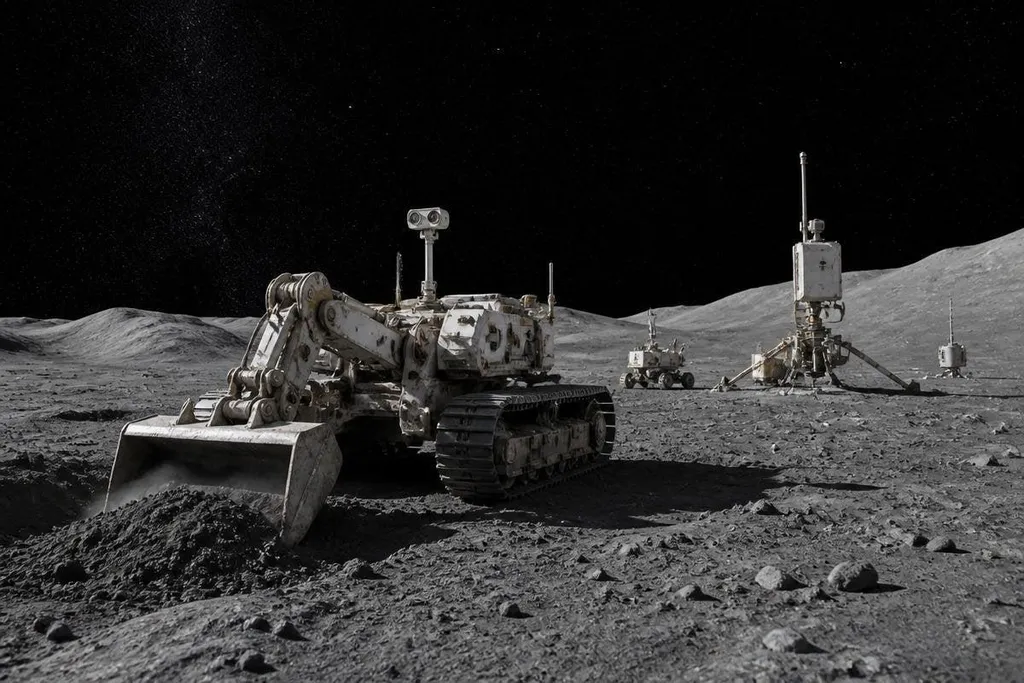
A Moon base would start with machines doing work that is hard to supervise from Earth. They could survey ground, move lunar soil, and set up equipment before people depend on it.
The plan is still an engineering problem, not a ready-made construction method. Robots must work in a vacuum, handle abrasive dust, and keep operating when direct control from Earth is delayed.
- Lunar gravity is about one-sixth of Earth’s, which changes how robots lift and drive.
- A lunar day and night each last about 14 Earth days.
- Signals take about 1.3 seconds to travel one way between Earth and the Moon.
Why robots would go first
The Moon has no useful atmosphere for people or ordinary machines. A robot would need sealed motors, protected electronics, and a way to shed heat without air carrying it away.
Temperature also changes sharply between sunlight and shadow. A base robot may need to work near a power system, move into shade, then return without its batteries or joints falling outside their allowed ranges.
Lunar dust creates another problem. Regolith, the loose soil covering the Moon, can work into seals and joints. A construction robot that looks fine after one short run may need very different parts for repeated digging, driving, and lifting.
Low gravity changes the work as well. A machine can lift more mass relative to its own weight, but its wheels or feet also have less force pushing them into the ground. A bucket that works on Earth could push the robot backward instead of filling cleanly.
Jobs a lunar robot could do
The first useful task would be mapping. A rover could measure slopes, rocks, loose soil, and routes between landing areas and work sites. That map would help engineers choose where to place power systems and shelters.
Next comes site preparation. Machines could clear rocks, level small areas, or move regolith into piles. Those piles could later help cover equipment, reducing the amount of shielding that has to be carried from Earth.
Robots could also place cables, unfold solar panels, and move tools between work areas. These jobs sound modest, but a damaged cable or badly placed panel can stop a larger system from working.
Construction is harder. A robot must hold parts in the right position, apply force without slipping, and check that a connection is complete. A person can adjust their grip after seeing a small error. A remote robot needs sensors and software that can detect the same problem.
Remote control has a limit
The Earth-Moon signal delay is short enough for commands, but long enough to make fast manual driving awkward. A person cannot steer every wheel movement as if they were standing beside the robot.
That points to shared control. An operator could choose a route or task, then let the robot handle small movements around rocks and slopes. The robot would still need to stop when its sensors find a condition that its software does not understand.
The Moon is about 384,400 km from Earth, so a construction robot can’t wait for a person to guide every wheel turn. It will need local autonomy for routine movement, with remote control reserved for choices its software can’t make safely. A dated Robot24.com report on lunar robotics can put that control problem beside a named machine or test.
The hard part is deciding where control should sit. Too much remote input slows the work. Too much autonomy can turn a small sensor error into damaged hardware, and repair on the Moon is not a normal service call.
What remains unproven
No general-purpose construction robot has shown that it can prepare a complete lunar work site without close human support. A convincing plan would need more than a rover driving over soil.
It would need to show repeated operation in dust, reliable tool changes, safe recovery after a wheel slip, and repairs that use parts already on site. Power storage would also need careful planning because a lunar night can last about 14 Earth days.
The design must account for failure. A base cannot depend on one robot for every job, yet sending spare machines adds mass and cost.
Engineers may choose several small robots for separate tasks, or one larger machine with more tools and more ways to fail.
I’d judge a lunar robot plan by its recovery steps before its construction demo. If the robot jams, loses contact, or damages a joint, the plan should show what happens next.
A practical test for any lunar robot plan
Use these checks when a company or agency presents a lunar construction concept:
- Name the task: state the exact job, material, tool, and finished result.
- Show repeat work: run the machine through enough cycles to expose dust and heat problems.
- Test the delay: operate it with Earth-Moon signal timing instead of instant commands.
- Explain failure: show how the robot stops, backs away, or gets repaired.
- Count the power: include the long lunar night, storage hardware, and restart plan.
- Separate the demo: label what works today and what remains a future design target.
The first lunar base will depend on machines that can keep working after small failures, not machines that complete one clean demonstration. The open question is whether builders can test that recovery on Earth before they send hardware across the 384,400 km to the Moon.